





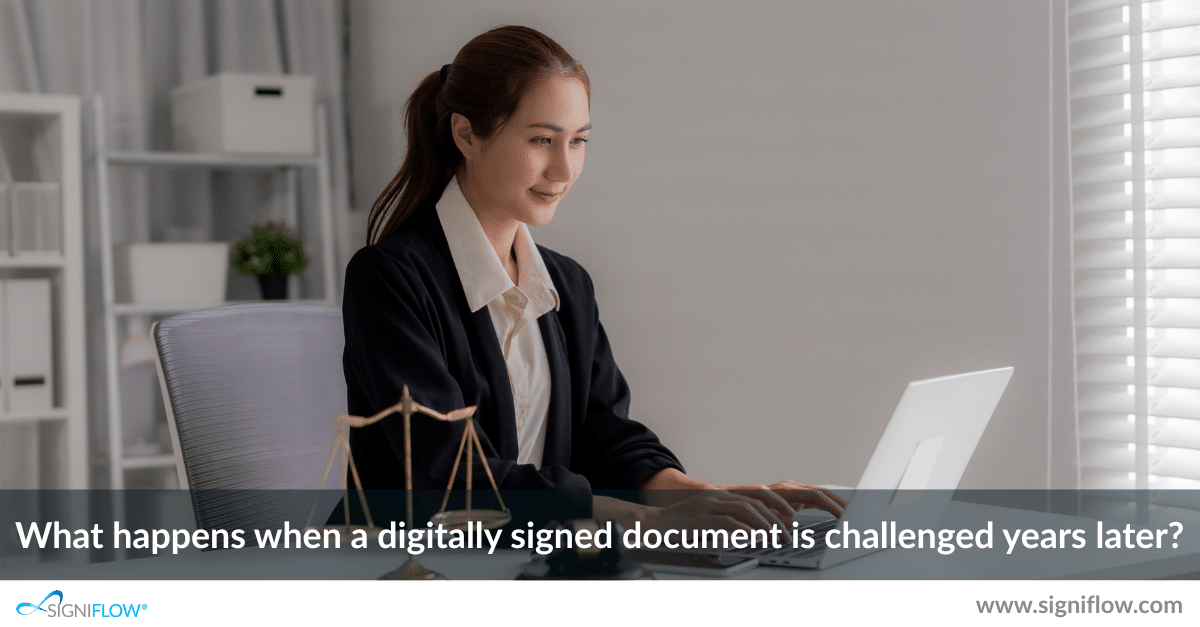
What happens when a digitally signed document is challenged years later?
What happens when a digitally signed document is challenged years after it was digitally signed? Many organisations assume that once a contract is digitally signed, risk is reduced and the matter is closed. Yet when a digitally signed agreement is scrutinised in court or by a regulator, the question is not whether it was convenient to execute, but whether the digitally signed evidence can still be proven authentic, intact, and attributable.
For legal and compliance leaders, a digitally signed record is not merely a completed workflow but also a potential exhibit in litigation, an item for regulatory inspection, or a cornerstone of institutional accountability. The real risk emerges long after execution, when systems have changed, certificates have expired, staff have moved on, and the organisation must still prove integrity beyond doubt.
When a digitally signed record is tested in court
When a digitally signed contract is presented in court years later, the burden of proof does not rest on the fact that it was easy to sign. It depends on whether the organisation can demonstrate authenticity, integrity, non-repudiation, and a clear link between the signer and the signature at the time of execution.
A digitally signed document must withstand scrutiny of certificate validity, identity verification processes, tamper evidence, and the security controls in place at the time. If the organisation cannot reconstruct that context with precision, legal defensibility weakens significantly.
Why a digitally signed agreement must survive time
Technology evolves rapidly, but a digitally signed agreement may need to remain defensible for a decade or more. Cryptographic standards change, certificate authorities update their policies, and software platforms are replaced, yet the legal obligation to prove authenticity remains constant.
If a digitally signed file cannot be independently validated in the future because it relied on short-term mechanisms or weak audit controls, the organisation may face reputational damage and regulatory scrutiny. Long-term validation is not an optional enhancement but a governance requirement.


How a digitally signed workflow should be structured for defensibility
The solution begins with designing every digitally signed workflow around evidentiary standards rather than user convenience alone. This means implementing strong identity verification, secure key management, detailed audit trails, and cryptographic sealing that detects any post execution alteration.
A digitally signed record must also be supported by time stamping and validation data that can be independently verified years later. Long-term validation mechanisms ensure that even if a certificate expires, the proof of its validity at the time of signing remains intact and demonstrable.
Why SigniFlow is passionate about digitally signed integrity
At SigniFlow, the question of what happens when a digitally signed document is challenged years later is not theoretical. It is central to how the platform is architected, tested, and continuously improved to serve regulated industries and public sector institutions.
SigniFlow’s commitment to digitally signed integrity stems from years of working with governments, financial institutions, and compliance-driven organisations where auditability is non-negotiable. In these environments, a signature is not a feature but a legal instrument that must endure scrutiny over time.
Why SigniFlow is the best option for digitally signed longevity
SigniFlow was built to ensure that every digitally signed document is defensible by design, incorporating advanced cryptographic controls, robust authentication options, and comprehensive audit trails that create a clear chain of custody from initiation to completion. This architecture reduces the risk that evidence will degrade or become unverifiable over time.
Beyond the technical controls, SigniFlow approaches every digitally signed deployment with a governance mindset, aligning workflows to regulatory requirements and internal compliance policies. The platform is designed to support long-term validation standards so that proof does not expire when technology cycles change.
Building institutional confidence in digitally signed records
For executives and boards, confidence in a digitally signed system comes from knowing that evidence will remain reliable despite organisational change. Staff turnover, system upgrades, and evolving compliance frameworks should not compromise the integrity of critical records.
A digitally signed environment that prioritises auditability, traceability, and secure storage contributes directly to institutional memory. Years after execution, the organisation must be able to reconstruct who signed, how they were authenticated, what document was presented, and whether any alteration occurred.
From problem to permanence with digitally signed assurance
The problem is clear: convenience alone cannot guarantee that a digitally signed document will survive legal challenge years later. The solution lies in embedding long-term validation, tamper detection, and rigorous audit controls at the core of every workflow.
SigniFlow provides digitally signed assurance by combining secure identity verification, cryptographic sealing, trusted time stamping, and comprehensive reporting within a single controlled environment. This integrated approach reduces reliance on fragmented systems that may weaken evidentiary strength over time.
The long-term responsibility of digitally signed governance
Legal and compliance leaders carry a long-term responsibility for every digitally signed agreement executed within their organisation. That responsibility extends beyond implementation to continuous oversight, policy alignment, and periodic review of evidentiary standards.
Choosing a digitally signed platform is therefore a strategic governance decision, not merely a procurement exercise. The right partner must demonstrate stability, regulatory alignment, and a clear commitment to defensibility as a permanent feature rather than a temporary enhancement.
Preparing for the moment, a digitally signed document is challenged
When a digitally signed document is challenged years later, the organisation will not be judged on how modern its interface once appeared. It will be judged on whether it can prove authenticity, integrity, and attribution beyond a reasonable doubt.
By designing every digitally signed workflow with long-term legal defensibility in mind, and by partnering with a provider that treats trust as infrastructure rather than marketing language, organisations position themselves to withstand scrutiny with confidence.
SigniFlow’s focus on permanence, auditability, and compliance ensures that, years from now, when the question arises, the answer is clear, provable, and defensible.