




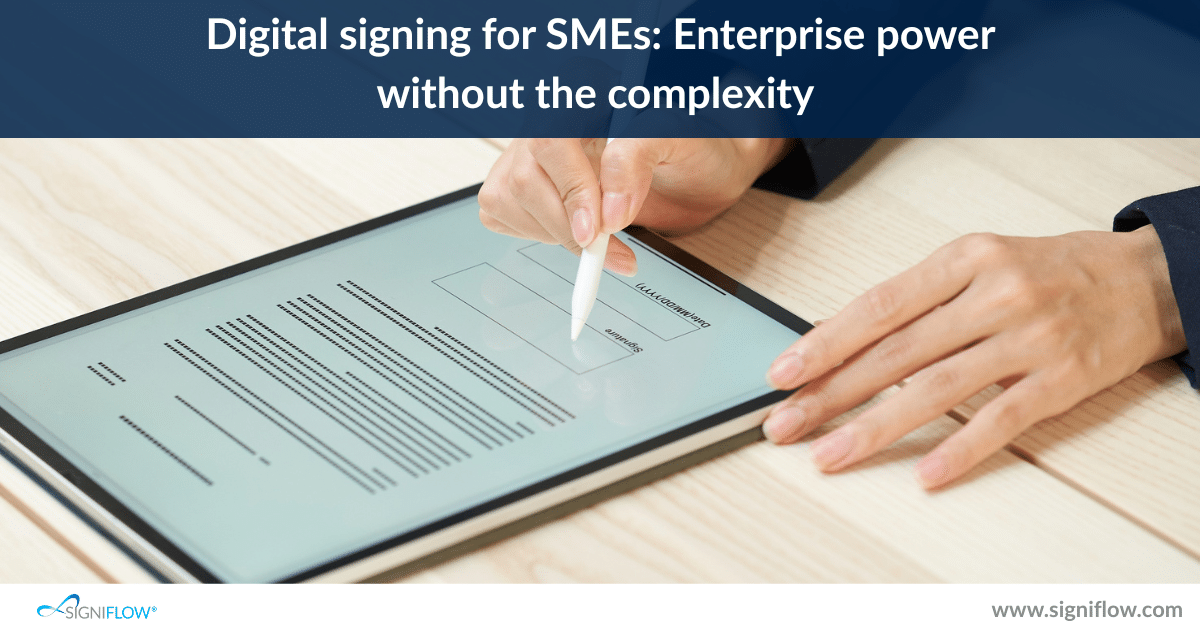
Digital signing for SMEs: Enterprise power without the complexity
Running a small or medium-sized business often means balancing growth with efficiency. Teams are smaller, budgets are tighter, and every hour spent on manual admin is time taken away from serving customers, closing deals, or building the business. Yet despite operating differently to large enterprise organisations, SMEs are still expected to maintain professional, secure, and compliant business processes that match enterprise standards.
This is especially true when it comes to documents and digital signing workflows.
Contracts, agreements, onboarding forms, quotations, approvals, and compliance paperwork remain a critical part of everyday business operations. Many SMEs still rely on printing, scanning, emailing, or physically signing documents simply because they believe digital signing platforms are too expensive, too technical, or built only for large enterprise environments.
For many growing businesses, the word enterprise still creates the impression that advanced business tools are complicated, expensive, and out of reach. As a result, digital signing is often overlooked by SMEs that assume these solutions are designed only for corporations with large budgets and dedicated IT teams.
The reality is that modern digital signing solutions are becoming far more accessible, giving SMEs the ability to work with enterprise-grade efficiency, security, and professionalism without the traditional enterprise complexity.
Why manual document processes slow businesses down
For years, the assumption that enterprise software is complicated and expensive was understandable.
Traditional business platforms often came with long implementation cycles, complex integrations, expensive licensing models, and features designed for massive organisations rather than growing businesses. Small businesses were left choosing between outdated manual processes or overly complicated systems that required technical expertise to manage effectively.
The problem is that manual document handling slows businesses down.
Waiting for printed contracts to be signed delays sales cycles. Chasing approvals over email creates unnecessary bottlenecks. Storing physical paperwork increases administrative overhead and compliance risk. Even simple tasks like onboarding a new client or approving an internal document can become frustratingly time-consuming when processes are not digitised.
In an environment where speed and customer experience matter more than ever, SMEs cannot afford inefficiency.
The rise of digital signing for small businesses
Customers today expect fast, seamless interactions. Employees expect flexible digital workflows that support remote work and mobile accessibility. Businesses need tools that allow them to operate professionally without adding complexity to already busy operations.
That is why digital signing has become increasingly important for businesses of every size.
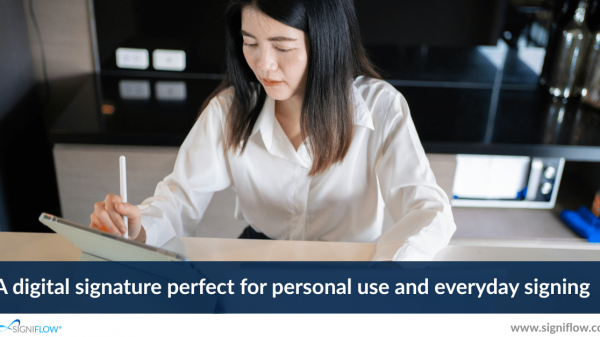
Digital signing solutions simplify the way organisations manage documents by allowing agreements and approvals to happen securely online from anywhere. Instead of printing and scanning paperwork, users can send, sign, track, and store documents digitally in a matter of minutes.
For SMEs, the value goes beyond convenience.
Digital signing reduces turnaround times, improves operational efficiency, enhances professionalism, and supports secure document management without requiring large internal IT teams. It allows smaller businesses to operate with the same speed and professionalism as larger enterprises while remaining agile and cost-conscious.
The challenge with traditional enterprise software
The challenge, however, has always been accessibility.
Many digital transformation tools still position themselves primarily toward enterprise clients, making smaller businesses feel excluded by pricing, complexity, or technical barriers. SMEs need solutions that deliver enterprise-level capability without enterprise-level implementation headaches.
This is where platforms like SigniFlow are changing the conversation.
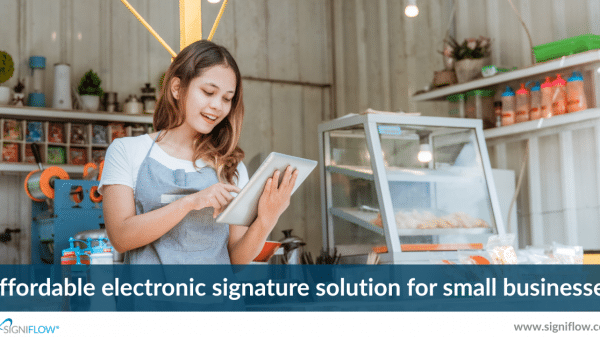
Rather than focusing only on large-scale enterprise deployments, SigniFlow provides a practical and accessible digital signing solution that works equally well for small businesses, growing teams, and individual users. Businesses can access secure digital signing functionality through an easy-to-use front-end experience without needing complex infrastructure or specialised technical knowledge.

Enterprise-grade security without the complexity
This approach makes digital transformation more realistic for SMEs.
Instead of navigating complicated systems designed for multinational corporations, small businesses can implement digital signing quickly and start seeing immediate operational benefits. Documents can be signed remotely, workflows can move faster, and teams can collaborate more efficiently without disrupting existing business operations.
Importantly, simplicity does not come at the expense of security.
As businesses continue moving toward digital operations, trust remains essential. SMEs still need confidence that their documents, customer information, and workflows are protected to enterprise-grade standards. Secure digital signing is no longer a “nice to have”; it has become a business necessity.
SigniFlow addresses this by combining usability with strong security credentials, allowing smaller businesses to benefit from trusted digital workflows without unnecessary complexity. Cloud deployment options, Office 365 compatibility, and flexible usage models further support accessibility for businesses that need solutions that work within their existing environments.
Affordable digital transformation for SMEs
Affordability also plays a major role in adoption.
Many SMEs avoid digital workflow solutions because they assume the cost will outweigh the value. In reality, the cost of inefficient manual processes is often far greater over time. Delayed approvals, lost paperwork, printing expenses, slower customer onboarding, and administrative inefficiencies all impact productivity and profitability.
Accessible licensing options help remove this barrier by making digital signing achievable even for smaller businesses and individual users who may previously have viewed enterprise-grade solutions as out of reach.
Simplicity is the future of digital workflows
The reality is that modern SMEs do not need more complicated software. They need smarter tools that simplify the way they work.
Digital signing should not require extensive onboarding, large implementation budgets, or dedicated technical teams. It should help businesses move faster, operate securely, and create better experiences for both employees and customers.
As more SMEs continue embracing digital transformation, the businesses that succeed will be the ones that adopt solutions built around simplicity, flexibility, and usability rather than unnecessary complexity.
Enterprise power no longer needs to come with enterprise frustration.
Today, small businesses can access secure, professional digital signing solutions that are practical, affordable, and designed for the way modern businesses actually work.