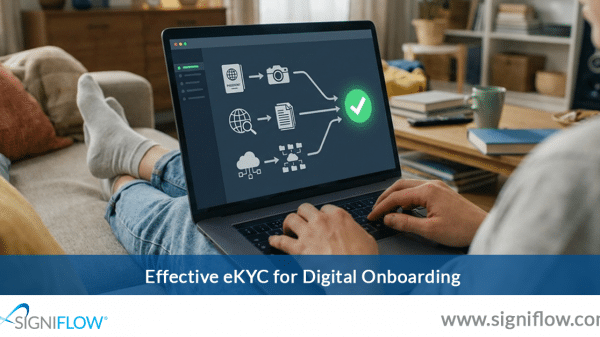









Organisations should evaluate an eKYC process for digital onboarding by looking beyond whether identity checks can be completed electronically. The assessment should consider what needs to be verified, which checks serve those requirements, what data is available in each country and how results that require further attention will be handled.
How should organisations evaluate an eKYC process for digital onboarding in practice? A useful framework is to assess four areas: verification requirements, the purpose of each check, local data availability and exception handling. This helps distinguish the capabilities of an eKYC process from the onboarding decisions an organisation remains responsible for making.
Start with what the organisation needs to establish
The first step is not selecting a technology or compiling as many checks as possible. It is defining what the organisation needs to know about an applicant.
Requirements will vary according to factors such as organisational policies, risk profile and legal obligations. An organisation should therefore identify the information it needs to establish before determining which checks belong in its onboarding process.
This provides a practical basis for evaluating eKYC. Instead of asking whether a solution offers a long list of checks, the organisation can ask whether the available checks answer the specific questions relevant to its onboarding requirements.
Separate checks according to their purpose
Identity-document verification, AML screening and local data verification should not be evaluated as interchangeable capabilities.
Identity verification compares information supplied by an individual with the identity document presented. It can establish a starting point for the eKYC process, but its purpose is not to identify every type of information that could affect an onboarding decision.
An AML check serves a different function. It screens for relevant information that may need consideration under the organisation’s customer due-diligence and risk policies. A possible match may require review rather than an automatic conclusion about the applicant.
Local data verification provides another type of input. Where appropriate sources are available, submitted information can be compared with relevant records in that country.
Evaluating each capability according to the question it answers makes it easier to understand both its value and its limitations.
Assess what can actually be verified in each country
An eKYC process that will be used across several markets needs to account for differences in local data availability.
A data source available in one country may not exist in another. Where similar sources do exist, they may not contain identical information or be accessible for the same verification purpose.
Organisations should therefore establish what can actually be checked in every relevant jurisdiction rather than assuming that one verification model can be replicated unchanged across markets.
For each local verification check, useful questions include what source is consulted, which submitted information is compared and what the result confirms. This prevents the existence of a local data check from being interpreted as confirmation of information it was not designed to verify.
Define what happens when a result is unclear
The way exceptions are handled is another important part of evaluating an eKYC process.
A check may be unsuccessful, inconclusive or return information that requires further review. These outcomes do not necessarily mean the same thing and should not automatically produce the same response.
Consider an AML check that returns a possible name match. The result does not, by itself, establish that the applicant is the person identified by the information returned. The organisation may need to review the result and determine whether additional evidence or escalation is appropriate.
Similarly, an identity document that cannot be successfully verified requires a response suited to that verification step, while an unavailable local data source presents a different issue.
Before implementation, organisations should determine who reviews these outcomes, what information may be required and when an application can proceed or needs to be escalated.
The Financial Action Task Force guidance on digital identity provides additional context on assessing whether digital identity systems are appropriately reliable in light of the risks involved.
Distinguish verification capability from onboarding decisions
A useful eKYC evaluation should also separate what the technology does from what the organisation decides.
Electronic checks can compare information, return results and provide inputs for assessment. Those capabilities should not be described as automatically determining whether an applicant satisfies every requirement relevant to onboarding.
The organisation remains responsible for deciding which checks are appropriate, how results should be interpreted and how its own policies, risk profile and legal obligations apply.
This distinction is particularly important when assessing AML results and exceptions. Automating the retrieval of information is not necessarily the same as automating the judgement that follows.
Consider how the checks work as one process
Individual capabilities matter, but organisations should also evaluate how they contribute to the overall onboarding process.
A coordinated eKYC process can follow a clear sequence: collect the required information, conduct the appropriate checks, identify results requiring attention, review exceptions and reach an onboarding decision.
This structure can help reduce unnecessary hand-offs while preserving the distinct purpose of each verification step.
It also gives organisations a clearer framework for determining which checks have been completed and what needs to happen when a check cannot produce a straightforward result.
Where SigniFlow’s built-in eKYC module fits
SigniFlow has progressed its capability from KYC to a built-in eKYC module, expanding the onboarding process beyond identity verification alone.
The module provides identity verification against an identity document as a starting point, together with an AML check and verification against relevant local data sources where these are available.
These capabilities can support different parts of an organisation’s eKYC process, but the appropriate configuration depends on the organisation’s own requirements. Its policies, risk profile, legal obligations and the availability of relevant data sources in each country all need to be considered.
A practical eKYC evaluation framework
When assessing an eKYC process, organisations can use four questions to guide the decision:
- What needs to be verified?
Define the identity information, risk considerations and other submitted details that need to be assessed during onboarding. - Which check answers each question?
Distinguish between identity-document verification, AML screening and relevant local data verification rather than treating them as equivalent checks. - What is available in each market?
Determine which relevant data sources can actually be accessed in the countries where onboarding will take place and what information each source can verify. - How will exceptions be handled?
Establish what happens when a check is unsuccessful, inconclusive or produces information requiring further review.
Using these questions shifts the evaluation away from simply counting available checks. Instead, organisations can assess whether the eKYC process provides the appropriate information and review paths for their particular onboarding requirements.
Choosing an eKYC approach around your requirements
An effective eKYC process is not defined by one verification result or by performing the greatest possible number of checks. It depends on selecting checks for a clear purpose, understanding what each result means and establishing appropriate routes for cases that require further attention.
Organisations evaluating eKYC should therefore consider both capability and context. What needs to be verified, which information is available locally, how results will be interpreted and how exceptions will be managed all influence the appropriate approach.
To evaluate how these capabilities could support your organisation’s onboarding requirements and markets, contact SigniFlow to arrange a demonstration of SigniFlow’s built-in eKYC module.