

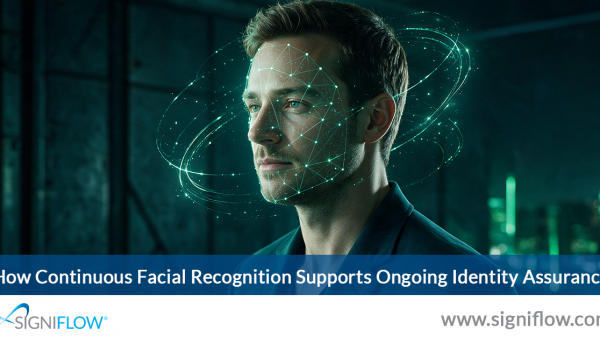





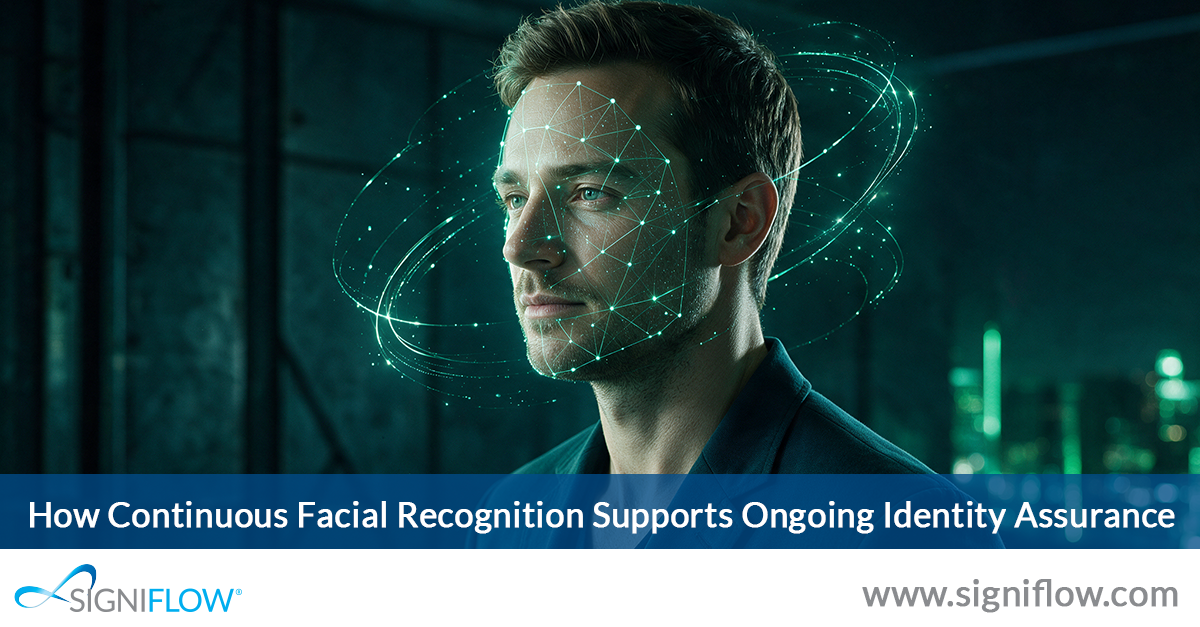
How Continuous Facial Recognition Supports Ongoing Identity Assurance
Continuous Facial Recognition addresses a simple but important question: is the person who started a digital session still the person using it? An identity check at login can establish who was present at the beginning, but it cannot necessarily show who remains behind the screen as the interaction continues.
Continuous Facial Recognition extends identity assurance beyond that first moment by continuing to assess whether the verified person remains present. This can provide an additional identity signal when a session involves sensitive information or consequential actions.
The gap between login and the end of a session
Most identity checks happen at the entrance to a digital process. A user enters credentials, completes a biometric check or verifies an identity document, and access is granted. Continuous Facial Recognition becomes relevant when an organisation also needs assurance after that opening check.
Imagine a customer joining a confidential remote consultation and verifying their identity at the start. Halfway through, the customer steps away while the session remains open and another person takes over. The opening check has already done its job, but Continuous Facial Recognition can provide a signal that the verified person is no longer present.
This is the practical difference between point-in-time verification and ongoing identity assurance. One establishes confidence at the beginning, while Continuous Facial Recognition seeks to maintain confidence as the session continues.
How the technology works
The process starts with a trusted facial reference linked to the verified user. Continuous Facial Recognition captures further facial samples during the session and compares them with that reference.
If the comparison remains consistent, the session can continue according to the organisation’s rules. If the face disappears or a comparison fails, Continuous Facial Recognition can trigger a predefined response, such as pausing an action, requesting another check or directing the user to a different verification route.
Biometric comparison does not produce perfect certainty. Continuous Facial Recognition uses similarity scores and thresholds, and the Information Commissioner’s Office explains that biometric comparison results are statistically informed estimates that can produce errors.


What liveness detection adds
Facial comparison answers whether the face at the camera resembles the verified reference. Continuous Facial Recognition also needs a way to assess whether the camera is seeing a real person rather than a photograph, replayed video, mask or other imitation.
Liveness detection supports that assessment within Continuous Facial Recognition. It forms part of what NIST calls presentation attack detection: methods intended to identify attempts to interfere with a biometric capture system.
Liveness should be treated as an additional safeguard rather than a guarantee. NIST’s testing of passive, software-based presentation attack detection has shown that performance differs between algorithms, which means organisations should examine the evidence supporting any Continuous Facial Recognition product.
When does ongoing identity assurance make sense?
Not every online action requires Continuous Facial Recognition. Repeatedly checking someone who is completing a low-risk task could add biometric processing and inconvenience without addressing a meaningful problem.
Continuous Facial Recognition becomes more relevant when losing control of a session could have serious consequences. Examples might include access to sensitive information, participation in a confidential interaction or the remote completion of a consequential action.
The decision can begin with one practical question: what could happen if the person who passed the opening check is no longer the person completing the interaction? Continuous Facial Recognition may be worth considering when the answer carries material risk; otherwise, a simpler control may be more appropriate.
What should an organisation assess?
Technology is only one part of the decision. Before adopting Continuous Facial Recognition, an organisation should understand:
- The risk that requires checks throughout the session
- The testing evidence for facial matching and spoof detection
- How false matches, false rejections and interrupted camera access are handled
- Where biometric data is processed and stored
- What notice, choice or alternative route is provided to users
- How accessibility, device quality and connectivity affect the experience
- What action follows an unsuccessful or uncertain check
The right design is not necessarily the one that checks most often. A responsible Continuous Facial Recognition deployment uses biometric checks for a defined purpose, treats uncertain results sensibly and gives people a clear route forward when the technology cannot reach a reliable result.
How YEO Messaging applies the technology
YEO Messaging describes its Continuous Facial Recognition technology as checking for the verified person’s presence throughout an active session rather than only at login. According to YEO Messaging’s product information, its approach includes anti-spoofing measures, liveness detection and depth verification.
YEO Messaging also states that biometric information is stored on the user’s device rather than in a central biometric database. Organisations considering YEO Messaging’s Continuous Facial Recognition technology should assess this product-specific claim and the supporting technical evidence against their own requirements.
Accessing YEO Messaging through SigniFlow
SigniFlow partners with and resells YEO Messaging’s Continuous Facial Recognition with Liveness product as supplied by YEO Messaging. YEO Messaging remains a separate third-party solution and is not built into or integrated with the SigniFlow application or workflows.
Organisations interested in Continuous Facial Recognition can enquire about YEO Messaging through SigniFlow without assuming that the technology forms part of another SigniFlow product.
Maintaining confidence throughout a digital session
An identity check at login provides a starting point. For some higher-risk interactions, Continuous Facial Recognition can provide an additional signal that the verified person remains present while the session continues.
The value of Continuous Facial Recognition depends on applying it to a genuine risk, understanding its limitations and designing an appropriate response when a check is unsuccessful or uncertain.
To learn more about YEO Messaging’s Continuous Facial Recognition with Liveness product, contact SigniFlow to discuss whether the technology is appropriate for your requirements.