




Digital Patient Admission Workflows
Digital Patient Admission Workflows connect the forms, acknowledgements, signatures, supporting documents and internal actions required to admit a patient. The aim is not simply to replace a clipboard with a screen. It is to help the admission move as one visible process, without leaving patients or staff to bridge the gaps between paper, email and disconnected systems.
Well-designed Digital Patient Admission Workflows can reduce repetitive handling and make it easier to see what has been completed, what is still missing and who needs to act next. That matters because admission administration happens at the exact moment when patients want clarity and healthcare employees need to focus their attention carefully.
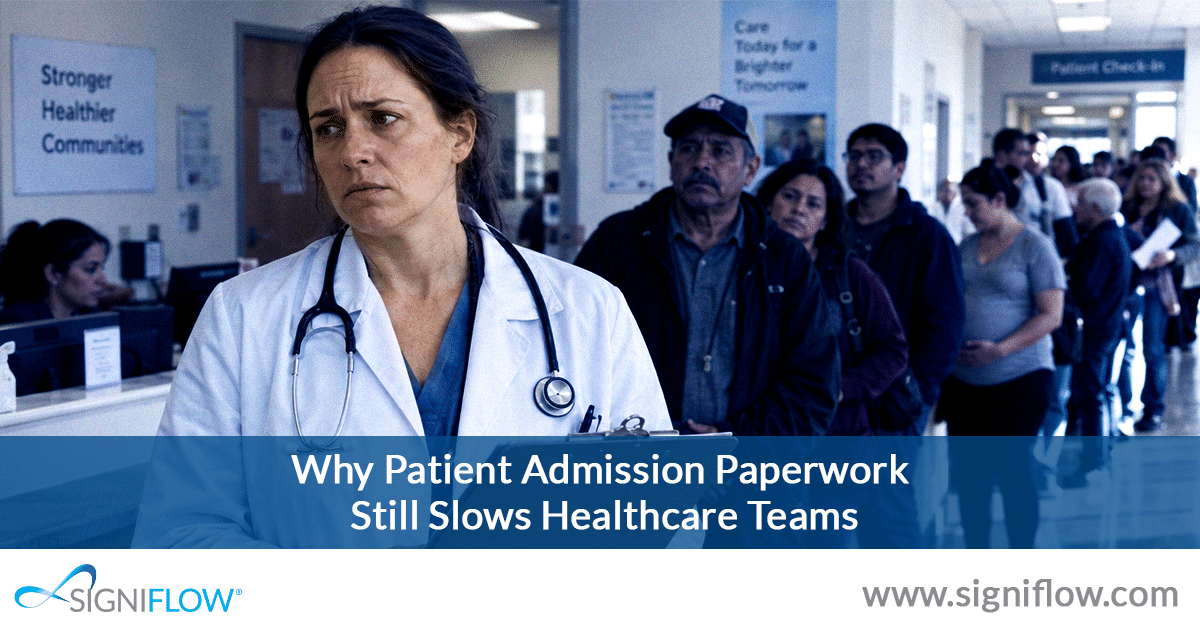
The admission desk sees every weakness in the process
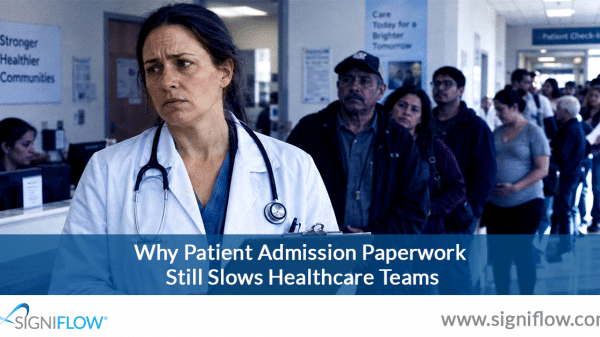
A patient rarely experiences admission as a set of internal systems. They experience a sequence of questions, forms and requests: provide these details, read this document, sign here, wait while someone finds the right record, and repeat information if something did not move with them.
Behind the desk, the work is more complicated. Staff may need to confirm that mandatory fields are complete, obtain the correct signatures, attach supporting documents, route information to another team and retain the final record. If one step is missed, the process moves backwards. Someone calls the patient, searches an inbox or asks a colleague which version is current.
That is why admission paperwork is not merely an inconvenience. It is a workflow problem involving people, documents, decisions and timing.
A digital form is only one part of the answer
Turning a paper admission form into a PDF can remove printing, but it does not automatically fix the work around the form. Staff may still download it, rename it, email it, request a signature and place the completed copy in another system. The paper has disappeared while the manual hand-offs remain.
The WHO Alliance for Health Policy and Systems Research warns that isolated digital interventions can add fragmentation and administrative burden. Its emphasis on integration over isolation is useful here: the value comes from improving the whole process, not adding another tool for employees to manage.
What should a connected admission workflow include?
A practical workflow starts by mapping what must happen before, during and after admission. It should answer basic operational questions clearly:
- Which documents does this patient need to receive or complete?
- Which fields and signatures are required for this admission type?
- Can the patient complete appropriate steps remotely or on their own device?
- What happens when information is incomplete or an exception needs human review?
- Which employee or department acts next?
- Where are completed documents retained, and who may access them?
- Can an authorised person see the progress and history without searching across inboxes?
Electronic signing can be one part of that design. NHS England Digital notes that clinicians sign numerous documents and records during a working day and describes digital signatures as a way to improve day-to-day efficiency in its supported context. The wider lesson is that signing should fit the work healthcare professionals already perform. It should not become a separate administrative destination.

Good automation leaves room for people
Healthcare admissions do not all follow the same path. A standard adult admission, a minor, an emergency case and a person assisted by a representative may require different documents or decisions. A rigid workflow can create new frustration if it cannot handle those differences.
Automation should move routine work and make exceptions visible. It should not conceal them or make decisions that belong to healthcare, legal, privacy or compliance professionals. Organisations also need to consider accessibility, language, device availability, staff training, identity requirements, data handling and the appropriate signing method for each document.
The right question is not, “Can we digitise this form?” It is, “Can patients and staff complete this admission clearly, with the right information reaching the right people?”
How Life Healthcare is changing the admission experience
This is already a real operational use case. According to SigniFlow’s published Life Healthcare story, Life Healthcare partnered with SigniFlow to digitise patient-admission documentation and electronic prescription issuance. The implementation uses electronic, biometric and digital signatures, with the case study describing an end-to-end chain of custody for admission documents.
The important idea is larger than the signature itself. Admission documentation, signing, document tracking and the next operational step form one connected journey. SigniFlow’s published account identifies Private Tenant, automation and process-digitisation technologies as part of the solution used by Life Healthcare.
This example should not be read as a promise that every hospital will achieve the same result, or that technology alone satisfies every healthcare requirement. It shows that admission paperwork can be treated as an enterprise workflow rather than a collection of isolated forms.
Questions to ask before redesigning patient admissions
Begin with one real admission journey and follow it from the patient’s first interaction to the completed record. Note every repeated field, print-and-scan step, email hand-off, manual reminder and moment when staff cannot see the current status.
Then ask whether the proposed workflow:
- follows the way admissions teams actually work;
- integrates with the systems that must receive or retain information;
- gives authorised employees useful status visibility;
- applies the appropriate signature and authentication method;
- provides a clear route for exceptions and human review; and
- remains understandable for patients using different devices or levels of digital access.
Give attention back to the admission
Patients arrive to receive care. Admissions employees are there to help them enter that care journey accurately and respectfully. Technology earns its place when it removes unnecessary document chasing without making the human interaction colder or more complicated.
If your admission process still relies on printing, scanning, inbox follow-ups or staff knowledge of where each document belongs, SigniFlow can help you map a connected digital workflow around the way your organisation operates. Book a personalised demonstration to explore one of your patient-admission journeys with our team.