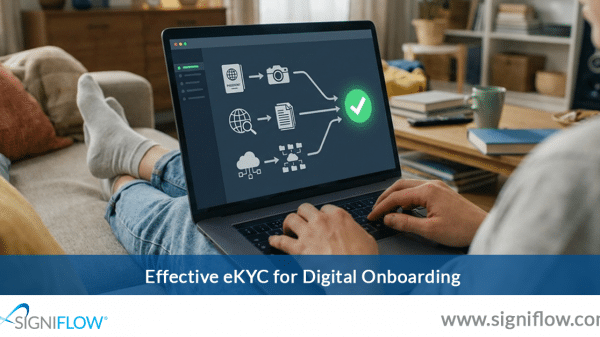









eKYC works for digital onboarding by allowing organisations to perform relevant Know Your Customer checks electronically rather than relying only on manual or in-person processes. Depending on the organisation’s requirements, this can involve verifying information against an identity document, performing an anti-money laundering check and checking submitted details against relevant local data sources.
Understanding how eKYC works for digital onboarding also means understanding that these checks are complementary. Identity verification, AML screening and local data verification answer different questions. Together, where appropriate, they can provide the organisation with information needed to assess an application and determine what should happen next.
What is eKYC?
Electronic Know Your Customer, commonly referred to as eKYC, is the electronic application of processes used to establish and assess information about a customer during onboarding.
It is more than simply moving an identity-document check online. A broader eKYC process can incorporate several checks according to what an organisation needs to establish, its risk profile, applicable legal obligations and the information available in the relevant market.
This distinction is important because no individual verification result necessarily provides all the information required for an onboarding decision.
How does information move through an eKYC process?
An eKYC process can begin when an applicant submits the personal information and identity documentation required by the organisation through a digital channel.
The submitted information can then be used for the relevant checks. Rather than treating every check as another version of identity verification, the organisation considers each result according to its specific purpose.
The process can therefore be understood as a sequence: information is collected, relevant checks are performed, results are assessed, exceptions are reviewed and an onboarding decision is reached.
The exact sequence and checks required will differ between organisations.
How does identity verification fit into eKYC?
Identity verification can provide the foundation for the process by comparing information supplied by an individual with the identity document presented.
This helps establish that the information being used corresponds with the document. It does not, however, answer every question an organisation may have about the applicant.
For example, identity-document verification is different from screening for information relevant to anti-money laundering requirements. It is also different from checking submitted information against other local data sources.
Keeping these functions separate helps organisations interpret the results more accurately.
How does AML screening differ from identity verification?
AML screening serves a different purpose within eKYC. It can identify relevant information that may need consideration under an organisation’s customer due-diligence and risk policies.
An AML result should be treated as information for assessment rather than an automatic decision about an applicant. A possible name match may require further review to determine whether the information actually relates to the person being onboarded.
This means the process surrounding the check matters. Organisations need to determine how potential matches and unclear results will be reviewed, what additional evidence may be required and when an application should be escalated.
The Financial Action Task Force guidance on digital identity provides further context on considering the reliability of digital identity systems in relation to the risks involved.
Why are local data sources relevant?
Local data verification can add country-specific context by allowing submitted information to be compared with relevant records available in a particular market.
However, the data sources available to an organisation can vary from one country to another. A particular source may not exist in every jurisdiction, may contain different information or may not be available for the same verification purpose.
For this reason, an eKYC process used across several countries may need to account for different verification options in each market.
Organisations should understand which source is being consulted, which information is being compared and what the resulting check does and does not confirm.
What happens when a check needs further review?
Not every electronic check will necessarily return a straightforward result. An identity-document verification could be unsuccessful or inconclusive, an AML check could return a possible match, or a relevant local data source might not be available.
A well-designed eKYC process therefore needs a route for exceptions.
The appropriate response depends on the check and the organisation’s requirements. An unclear result may require additional information, manual review or escalation before onboarding continues.
This is an important distinction between automating checks and automating decisions. Electronic checks can provide information efficiently, but organisations still need appropriate processes for interpreting that information.
How does SigniFlow support eKYC?
Once the different parts of eKYC are understood, organisations can consider how those checks are brought into their own onboarding processes.
SigniFlow has progressed its capability from KYC to a built-in eKYC module. The module expands beyond identity verification alone by adding an AML check and verification against relevant local data sources where these are available.
Identity verification against an identity document can provide the starting point, with other checks added according to the organisation’s onboarding requirements.
The appropriate configuration depends on factors including organisational policies, risk profile, legal obligations and the data sources available within each country.
From electronic checks to an effective onboarding process
eKYC is best understood as a coordinated process rather than a single electronic test. Different checks provide different information, and the value of the process depends on selecting the appropriate checks and understanding what their results mean.
For organisations designing digital onboarding, this means considering not only which checks can be performed electronically, but also how results will be assessed, how exceptions will be handled and which verification sources are available in each market.
To see how this approach can be applied to your organisation’s onboarding requirements, contact SigniFlow to arrange a demonstration of SigniFlow’s built-in eKYC module.